
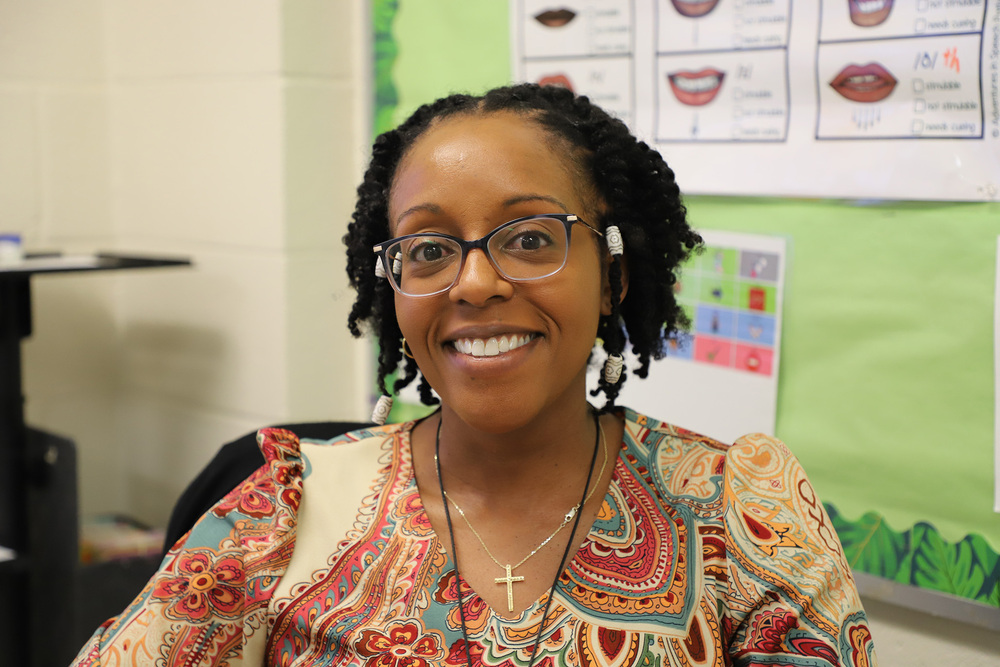
For Shani Whilby, helping a child communicate is about far more than correctly producing a sound or learning a new word. It is about making sure students know their voices matter – and giving them the confidence to use those voices wherever life takes them.
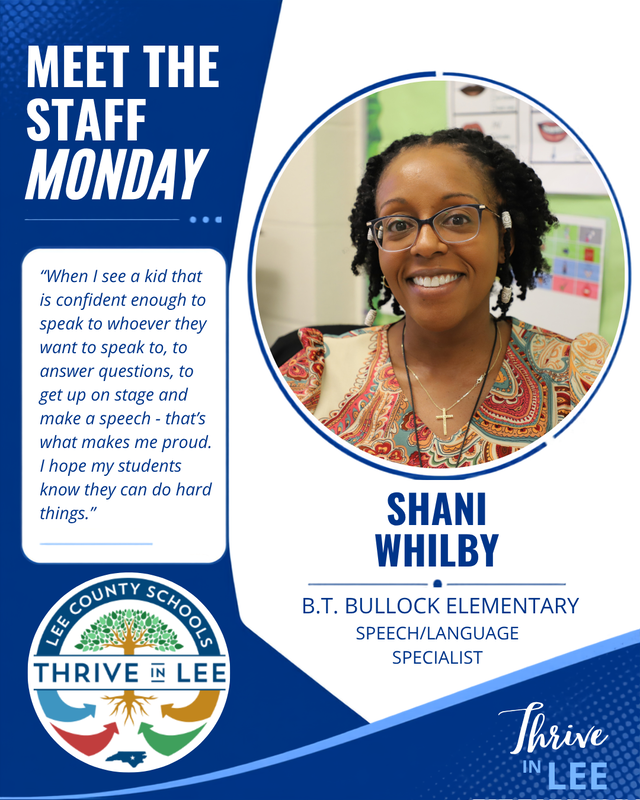
“When I see a kid that is confident enough to speak to whoever they want to speak to, to answer questions, to get up on a stage and make a speech, that’s what makes me proud,” said Whilby, a speech therapist and teacher at B.T. Bullock Elementary School. “Whether they have a mistake in their speech or not, they have the confidence that they can get up and do this speech or answer this question and feel like they have just as much of a right or ability to do it.”
That passion for helping others communicate began long before Whilby arrived at B.T. Bullock, where she has spent all 17 of her years with Lee County Schools.
Growing up outside of Washington, D.C., in Maryland, Whilby worked as a nanny in high school for a young girl with spina bifida who was nonverbal and faced motor challenges that made traditional sign language difficult. The experience sparked Whilby’s interest in communication.
At 16, she attended a full-immersion American Sign Language program at Gallaudet University.
“I absolutely loved it,” she recalled, smiling as she thought about the baseline for her journey in communication disorders.
Still, speech-language pathology was not originally part of her college plan. Whilby initially intended to study psychology. During a college visit, however, a discouraging conversation with a dean sent her flipping through the school’s course catalog where she stumbled across a program in Communication Disorders.
“I had never really thought of [it] before,” Whilby said. “I just thought that sounded amazing because I could help people communicate. That really was where it happened, even though I didn’t end up going to that school.”
 After college in Boston, Whilby and her husband began looking for somewhere warmer to call home. Their pastor in Boston had started a church in Durham, providing a connection to North Carolina that brought them south, and then their first visit to Sanford made a lasting impression.
“When we came to Sanford the people were just unbelievably friendly and open,” she said. “We just fell in love with it on our first visit.”
Whilby initially worked in private practice, completing contracts with hospitals, nursing homes and schools. Those experiences helped her discover that working with elementary-aged children was where she wanted to be.
“Kids are just 100% who they are,” she smiled. “Big personalities. So unique, so open to new things. Kids are incredibly smart and can learn so much more than we sometimes give them credit for. They are just fun, too.”
That realization led her to Lee County Schools and B.T. Bullock Elementary, a school she says has become home.
“Bullock really does have like a special sauce,” she said. “It is hard to describe, but it really has such a loving environment. We have a common culture where I honestly feel like everyone here loves kids, they value kids and education … Bullock just feels like home. It feels like where I’m supposed to be.”
Over her 17 years in the district, Whilby has also watched her profession evolve. One of the most significant changes has been increased access to Augmentative and Alternative Communication (AAC) devices, which provide another way for students who cannot rely on speech alone to communicate.
At the same time, she has seen the demand for speech and language support increase, particularly since the COVID-19 pandemic. Students are in need of help not only with articulation, but also with vocabulary, language development and broader communication skills more frequently.
“The total number of kids who need support has really increased,” Whilby highlighted. “So, the challenge really is just making sure we help everyone who needs help.”
Whether working one-on-one with a student or in a small group, Whilby values the relationships that form along the way. Those smaller settings provide her an opportunity to understand students as individuals and see their personalities emerge while supporting them beyond a particular speech or language goal.
At the heart of that work is one message she hopes students carry with them long after they leave her classroom: “I would hope that a student understands that they are capable of doing hard things.”
For Whilby, communication is fundamental to making that possible.
“There are so many things that make a huge impact in people’s lives,” she said. “Communication is one of those things. It is just a basic human right that often gets overlooked.”
And each time a student confidently raises a hand, answers a question, starts a conversation, or stands in front of a crowd, Whilby gets another reminder of why she chose this work.
“Working in this role really is just a chance to even the playing field for a lot of kids and people,” Whilby explained.