
AIG and Advanced Learning in Grades K-5
Early Entrance to Kindergarten
The NC Board of Education maintains a state policy regarding early entrance to kindergarten (NC State BOE Policy KNEC-001). Parents should consult with their child’s pediatrician to receive a referral to a licensed psychologist who may administer the necessary aptitude, intelligence, and/or achievement tests. The school district does not provide this testing to families, and the school district does not provide referrals to specific licensed psychologists. Parents with additional questions not addressed by the state policy may contact the Principal at their child's future school or the AIG Coordinator for Elementary Schools at Central Office.
Grade Acceleration and Single-Subject Acceleration (K-8)
Any K-8 student has the opportunity for grade acceleration (“skipping a grade”) and single-subject acceleration. Through grade acceleration, students who demonstrate that they are developmentally ready for a higher grade level than the one in which they are currently placed may be placed in one or more grades higher than their age-level peers. (For example, a student who by age would be placed into second grade is shown to be developmentally ready to be placed directly into third grade, as opposed to second grade, would be grade accelerated.) Through single-subject acceleration, students with a demonstrated mastery of grade-level content for one or more individual subjects (e.g. math, language arts) may enroll in that subject (or subjects) at one or more grade levels above their age-level grade while remaining enrolled with their age-level grade for the remainder of their subjects. (For example, a seventh grade student taking eighth-grade English Language Arts would be considered cases of single-subject acceleration.) For either acceleration pathway, it is important to ensure that concepts and content are not missed that may cause future learning issues as well as social and emotional considerations for an accelerated student, and students may be highly gifted in one area and not others.
K-2 Teacher's Observation of Potential in Students (TOPS) Portfolio
Teachers use U-STARS~PLUS TOPS Folders as a tool to help systematically observe and recognize children who have outstanding potential and who may be gifted. TOPS Folders engage teachers to make intentional and purposeful observations so that those observations can be used to provide more effective instruction and focus on individual strengths, thus reinforcing the “at-potential” mindset. TOPS Folders are organized around nine domains:
learns easily
shows advanced skills
displays curiosity and creativity
has strong interests
shows advanced reasoning and problem solving
displays spatial abilities
shows motivation
shows social perceptiveness
displays leadership
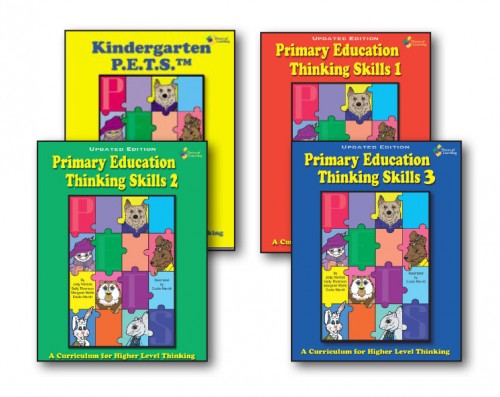
K-2 Primary Education Thinking Skills (PETS)
PETS™ (Primary Education Thinking Skills) is a systematized enrichment and diagnostic thinking skills program. Lessons are presented in convergent analysis, divergent synthesis, visual/spatial thinking, and evaluation, suitable for grades K-3. The program aligns to the higher levels of Bloom's Taxonomy.
PETS™ 1, the red book, introduces the six thinking specialists of Crystal Pond Woods:
Dudley the Detective, the convergent/deductive thinker
Isabel the Inventor, the divergent/inventive thinker
Sybil the Scientist, the convergent/analytical thinker
Yolanda the Yarnspinner, the divergent/creative thinker
Max the Magician, the visual/spatial thinker
Jordan the Judge, the evaluative thinker
Included in the 24 lessons are encounters with the animal characters who are engaged in problem-solving scenarios calling for their types of thinking -- four lessons involving each character (two whole class lessons to help identify talented learners with accompanying reproducible activities, and two small group lessons for identified students and accompanying reproducible activities).
Resource Classes with the AIG Specialists
AIG Specialists teach pull-out classes of reading, math, and intellectually gifted students to extend, enrich, and accelerate the Standard Course of Study (SCOS), explore student interest, and provide opportunities for critical thinking, collaboration, creativity and problem solving. These classes may include students identified as reading-only, math-only, intellectually-only, or any combination of those gifted areas.
AIG Specialists may incorporate lessons and activities such as:
Book Club / Novel Studies
Young Authors Contest
Exercises from Caesar's English
Noetic Math Competition
Hands-On Equations
Science Olympiad STEM activities
Living Wax Museum History Projects
Who Was? Books and History Bee
Specialists will develop and teach lessons to understand what it means to be gifted, and to address the social and emotional needs of gifted students.
Talent Development
Students who show the potential for AIG identification but who do not yet meet the criteria for identification can still participate in the Talent Development program.
Specialists push into classrooms or pull small groups of students who participate in the Talent Development program to help develop critical thinking skills and problem solving.
Students participating in Talent Development continue to be monitored and may be reassessed to determine if they meet the criteria for AIG identification in 4th and 5th grades.
Additional Opportunities
Students receive differentiated curriculum in the area of identification in the regular classroom with their general education teacher.
A variety of whole-class encore lessons are offered in Arts Education, which may include Visual Arts, Music, Theater, and/or Dance depending on teacher availability.