
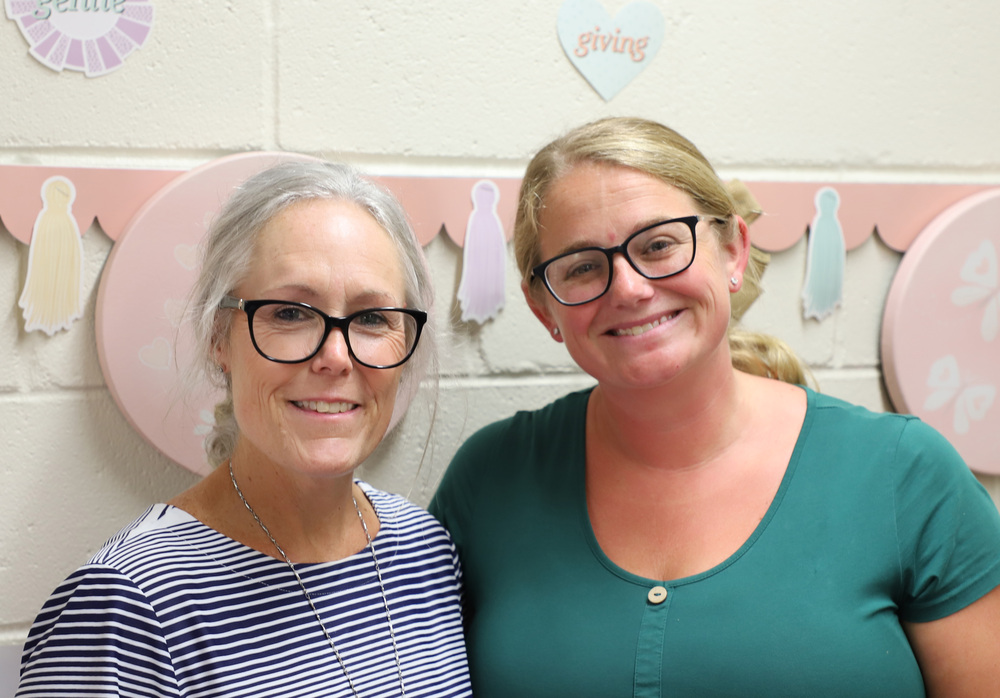
At J. Glenn Edwards Elementary School, academic support is not just about helping a student catch up. It is about figuring out what students need, helping teachers find the right strategies, and working together to create growth that lasts.
Study, support, and interventions that move the needle at J. Glenn Edwards is the work of veteran teachers Dana Mazurowski and Maggie Womble - the JGE Instructional Support Team.
Their days may look different from those of a traditional classroom teacher, but their impact reaches across classrooms and grade levels. They analyze student data, provide interventions, coach teachers, support classroom instruction and work together to ensure students receive the support they need to grow.
“I do a little bit of everything,” Mazurowski said. “Basically, I just try to provide support for the students and teachers that need it.”
Womble’s role similarly centers on identifying needs and finding ways to respond. She focuses on grades three through five while Mazurowski works more at the kindergarten through second grade levels. Through M-Class testing and other diagnostic tests and data, the pair comb through student results and work with teachers to develop strategies to best support each student in the classroom.
“It might be pulling a student for one-on-one or small group support or it could be helping coach a teacher on how to instruct a particular skill,” Womble explained. “We may even push into a classroom as an extra hand for group instruction with students.”
The combination of student support and teacher support is what makes their work so important.
Growing Readers, Growing Teachers
 One of the team’s biggest areas of focus has been strengthening early reading skills. Mazurowski has spent the past several years concentrating on kindergarten through second grade because she believes that strong foundational reading skills can make a difference as students move into the upper grades.
“If you can get the kids to read, the comprehension will come,” Dana smiled.
Now, the team is beginning to see the payoff.
“In the past two years, I’ve seen a huge change,” Dana said. “The kids can read already when they get to third grade. Now the teachers can work on what they need to master comprehension skills.”
Womble sees that growth firsthand as she works with third-grade readers.
“With the students that are coming up - it is easy to see - they’re reading already,” she said. “They can read so much better.”
For Mazurowski, the most exciting part is not simply seeing improved data. It is seeing teachers recognize that their work is making a difference.
“I want the teachers to feel like their work paid off,” she said. “They always feel like they’re doing so much work and are never seeing the results. But I think now they’re finally able to see some tangible things.”
That is ultimately what instructional support at J. Glenn Edwards is about - creating a cycle of support in which students grow because teachers are supported, and teachers grow because they have the tools, collaboration and information they need to help their students.
A Team Built on Relationships
Both Dana and Maggie believe that relationships are at the heart of effective support.
“I just feel like if you have a relationship with kids and with parents, they’re going to learn better and they feel more comfortable coming to you if there is a problem,” she explained. “You always work harder for people you care about and make you feel like you matter.”
Dana has found that her role allows her to build relationships not only with students but also with the teachers she supports. And some of her favorite moments are the simplest ones - seeing a student in the hallway who recognizes her and stops to say hello.
“When a little kid comes up and gives me a hug,” Dana grinned, “that’s what makes me proud.”
Those relationships are part of what allows the academic support team to do its job effectively. They are not simply looking at test scores or identifying students who need intervention. They’re getting to know the people behind the data and working alongside the educators directly responsible for helping them succeed.
Supporting the People Who Support Students
Dana and Maggie also emphasize the importance of collaboration. Their work connects students, teachers, administrators, and district-level support, creating opportunities to share strategies and work toward common goals.
Womble describes JGE as a place where people are willing to support one another.
“I just feel like everyone is supportive,” she said. “The administration, the support of all my coworkers. If I need something, they’re there.”
Dana said the same culture of support allows educators to become better at what they do.
“It really does start at the top,” she said, describing the support she receives from the Lee County Schools’ leadership and reading curriculum team.
The result is an academic support model centered not on one person solving a problem, but on educators working together. As Mazurowski and Womble continue to support teachers and students across J. Glenn Edwards, they’re seeing evidence that the approach is working. They are seeing stronger readers, and are now seeing teachers who get to see the results of better prepared students for themselves.
For Mazurowski, that’s the heart of the job. She said, “I’m just here to support and help the teachers so they have what they need for students. I’m excited that we are getting to see the results.”